
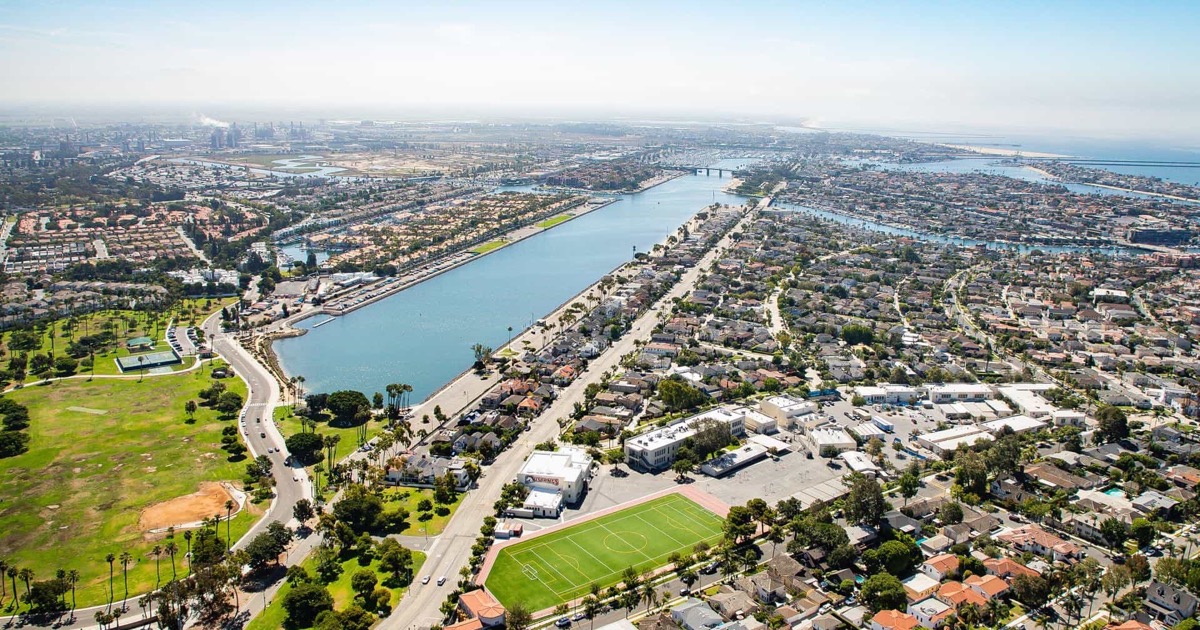
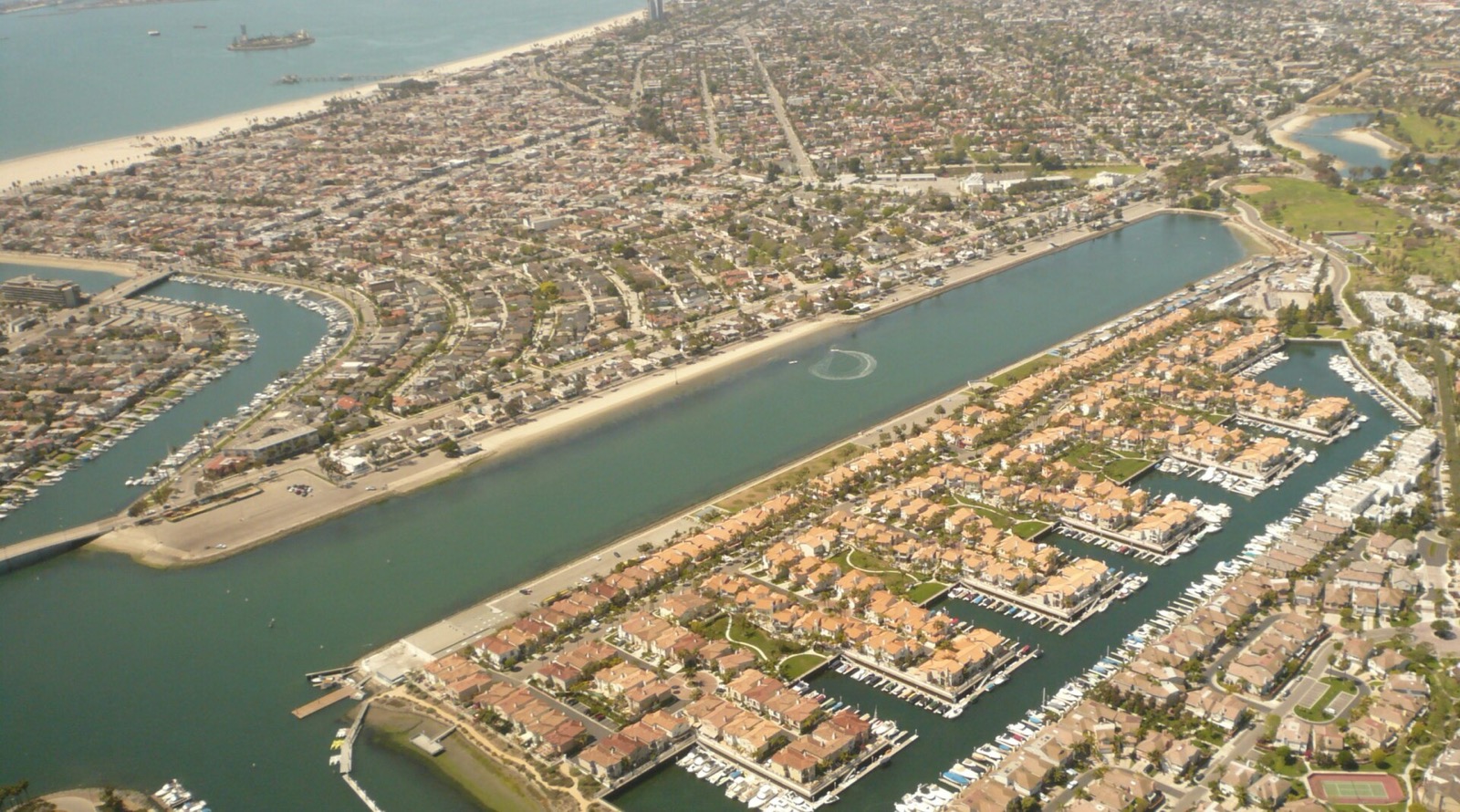
Many mornings, before most of Long Beach is awake, long, narrow rowing boats slide out onto Marine Stadium, a straight stretch of water at the north end of Alamitos Bay. The rowers who train there are using one of the most storied pieces of water in Southern California. The State of California calls Marine Stadium “the first manmade rowing course in the United States,” and in the summer of 2028 the world will be watching it again.
A lagoon that was 500 meters too short
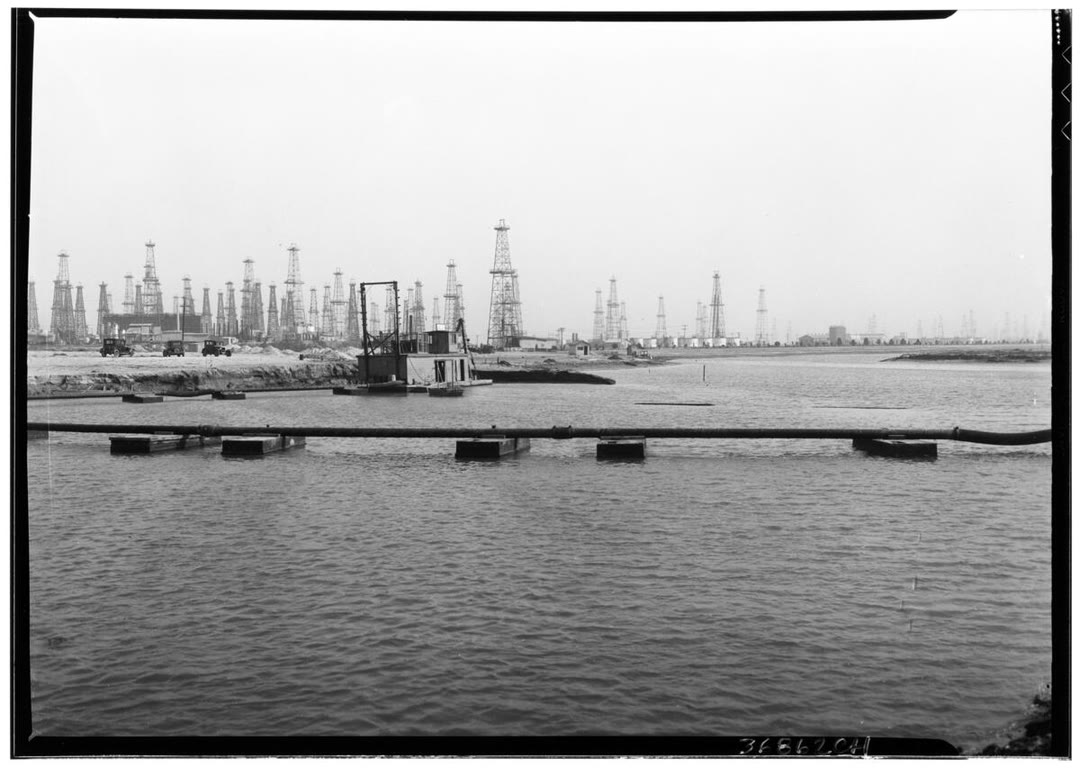
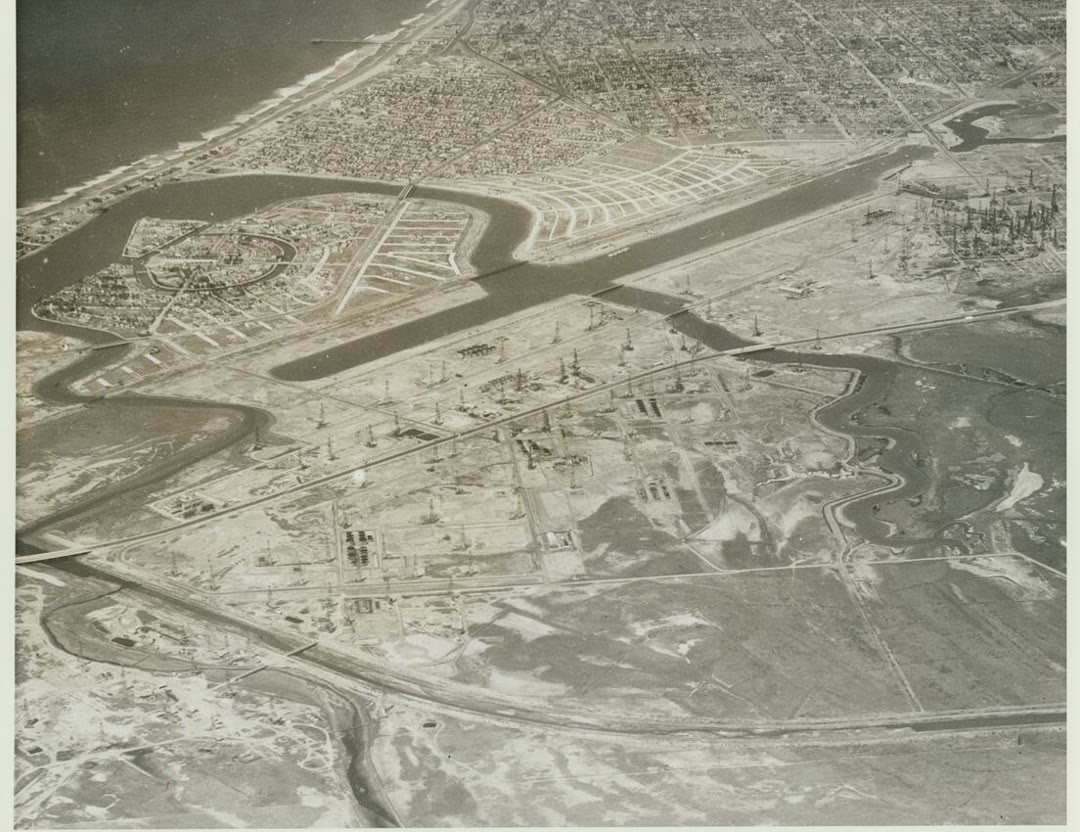
Marine Stadium began as part of the marshy estuary at the top of Alamitos Bay. The City of Long Beach bought the land in 1923, in the same purchase that included Recreation Park and Colorado Lagoon, and dredged the old estuary into a channel in 1925.
When Los Angeles won the 1932 Olympic Games, the organizers needed a rowing course, and nothing in Southern California fit. Their official report, published after the Games, explains what happened next. They found “a lagoon within one of the parks of the City of Long Beach that was ideal in every main respect except length, it being about five hundred metres too short.” The city agreed to dredge the lagoon to the needed length and depth, straighten its sides and fence the whole course.
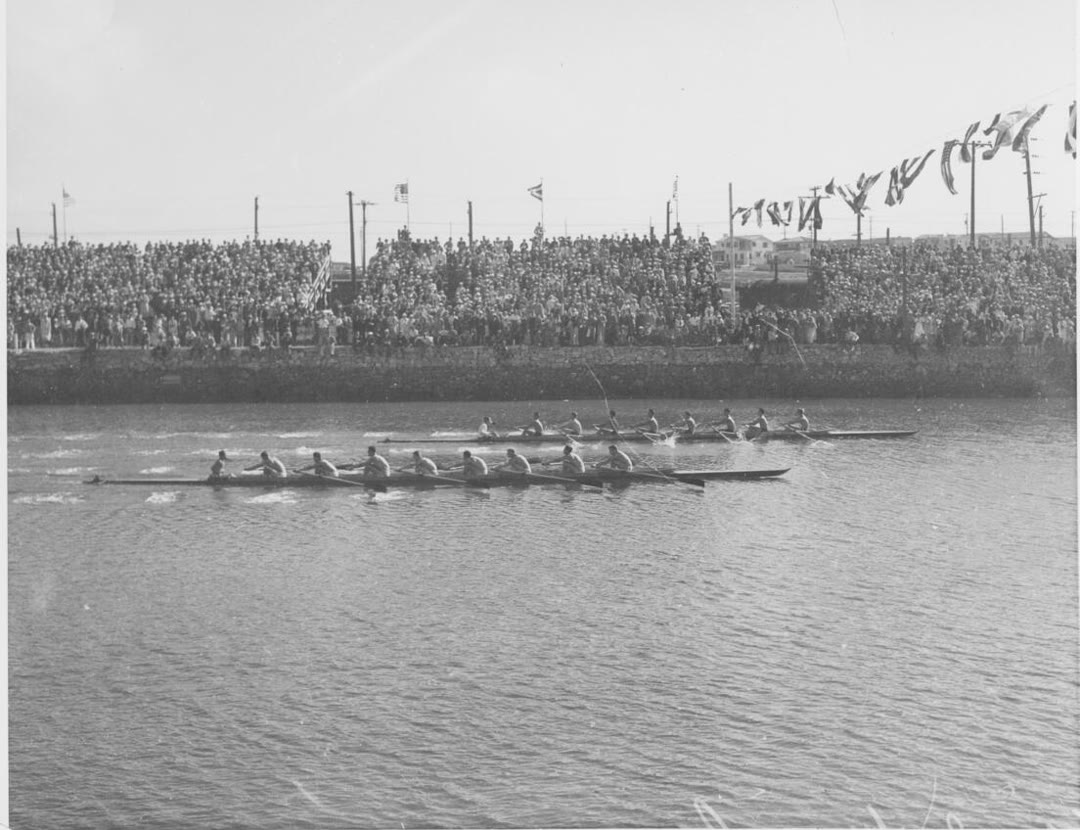
The Olympic organizers built everything else: grandstands, docks, starting platforms and a boathouse. The international rowing federation sent a boathouse plan from Switzerland, sized for about sixty racing shells, along with a building that could house two hundred rowers. When it was done, the report describes “a two thousand metre stretch of quiet sea water” lined with sloping sandy shores, wide enough for four crews to race side by side. That width meant fewer heats, so rowers could reach the finals at their best. The stadium had 17,000 seats, 5,000 permanent and 12,000 temporary, plus two miles of standing room along the banks. At the end of the Games, the organizers gave it all to the city.
The summer of 1932
All of the Olympic rowing training was held at Marine Stadium, and the racing ran from Aug. 9 to 13, 1932. According to the official report, 152 rowers from 13 countries competed in seven events. The United States won three of them: the double sculls, the pair with coxswain and the eights. Great Britain won two, the pair and the four without coxswain. Germany won the four with coxswain, and Australia’s Robert Pearce, the 1928 champion, won the single sculls again.
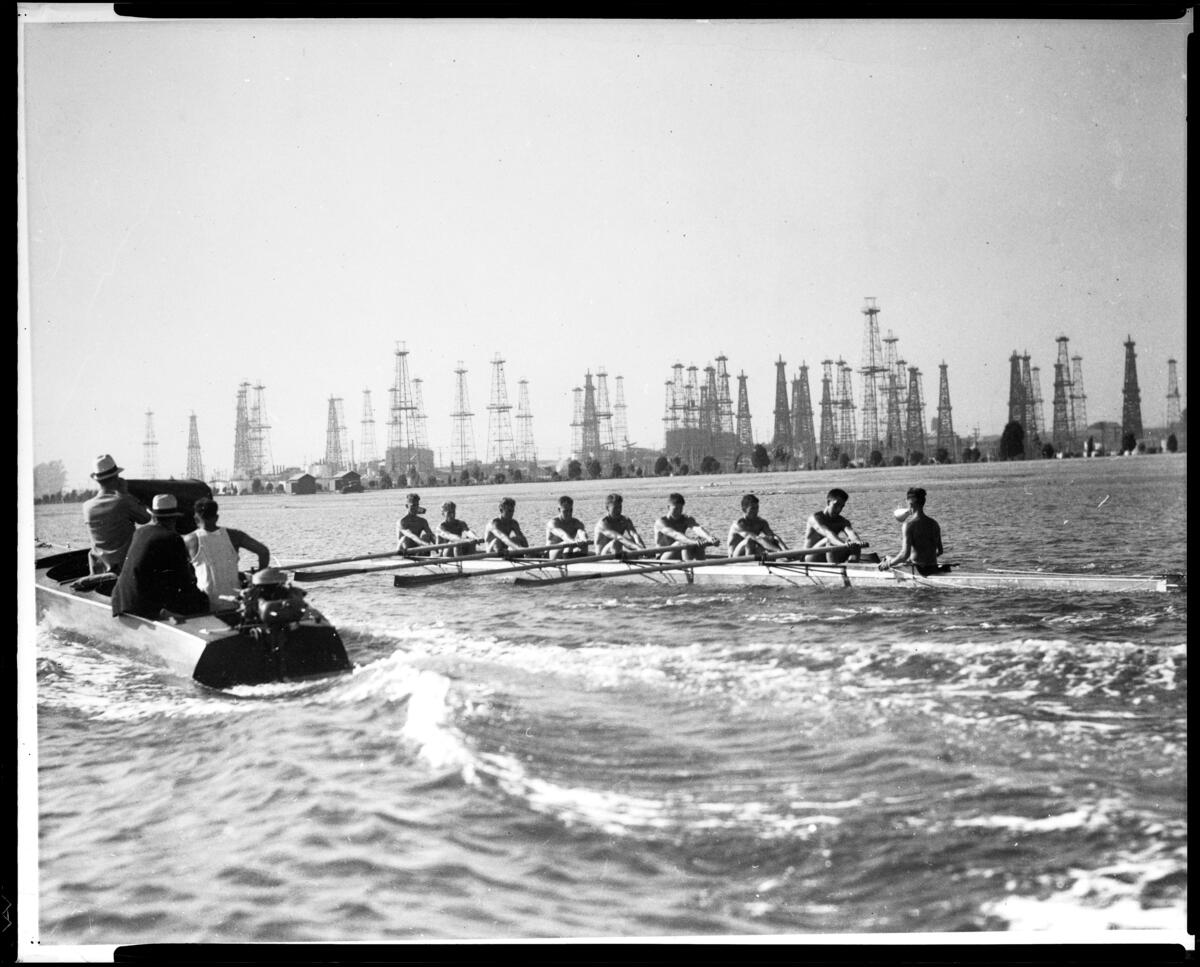
The big day was Saturday, Aug. 13, with the final of the eights, the marquee race of any regatta. The United States had won the three previous Olympic eights titles and was represented by the University of California, Berkeley crew. Italy led early. The official report says the four crews finished less than a length apart and that the Americans “won by the margin of a few feet.” The Long Beach Press-Telegram’s Art Cohn, writing the next morning, put the winning margin at one-fifth of a second and the crowd at 50,000, with a forest of oil derricks in the background.
A rowing town after the Games
The Olympians went home, but the rowing stayed. According to the City of Long Beach, the original Long Beach Rowing Club, later the Long Beach Rowing Association, was formed right after the Games by 25 Long Beach businessmen. Generations of local crews have trained on the same water since.
Marine Stadium also kept its place in Olympic rowing. The state landmark plaque records that it hosted the 1968 and 1976 United States men’s Olympic rowing trials and the 1984 United States women’s Olympic rowing trials. Marine Stadium became California Historical Landmark No. 1014 in 1994, and the plaque stands at the Pete Archer Rowing Center at the end of Boathouse Lane.
What about 1984?
When the Olympics came back to Los Angeles in 1984, Long Beach was a big part of them, just not at Marine Stadium. The 1984 official report lists four Long Beach venues: archery at El Dorado Park, fencing at the Long Beach Convention and Entertainment Center, volleyball at the Long Beach Arena and yachting at the Downtown Shoreline Marina. Sailing was first planned for Alamitos Bay, but after a 1982 test regatta the organizers moved it downtown.
Rowing and canoeing went to Lake Casitas, near Ojai, because, in the report’s words, “the cost of building a rowing/canoeing basin was prohibitive.” Marine Stadium still had its own 1984 Olympic moment: that year, the country’s best women rowers raced here in the U.S. Olympic trials for their places on the team.
Speedboats, wakeboarders and everyday rowers
Marine Stadium has always shared its water. The Southern California Speedboat Club has held professional powerboat races there from 1946 on, and the city calls the stadium the birthplace of powerboat racing on the West Coast. The club’s Long Beach Sprint Nationals ran here most Augusts for decades, though the race is not on the city’s 2026 event calendar.
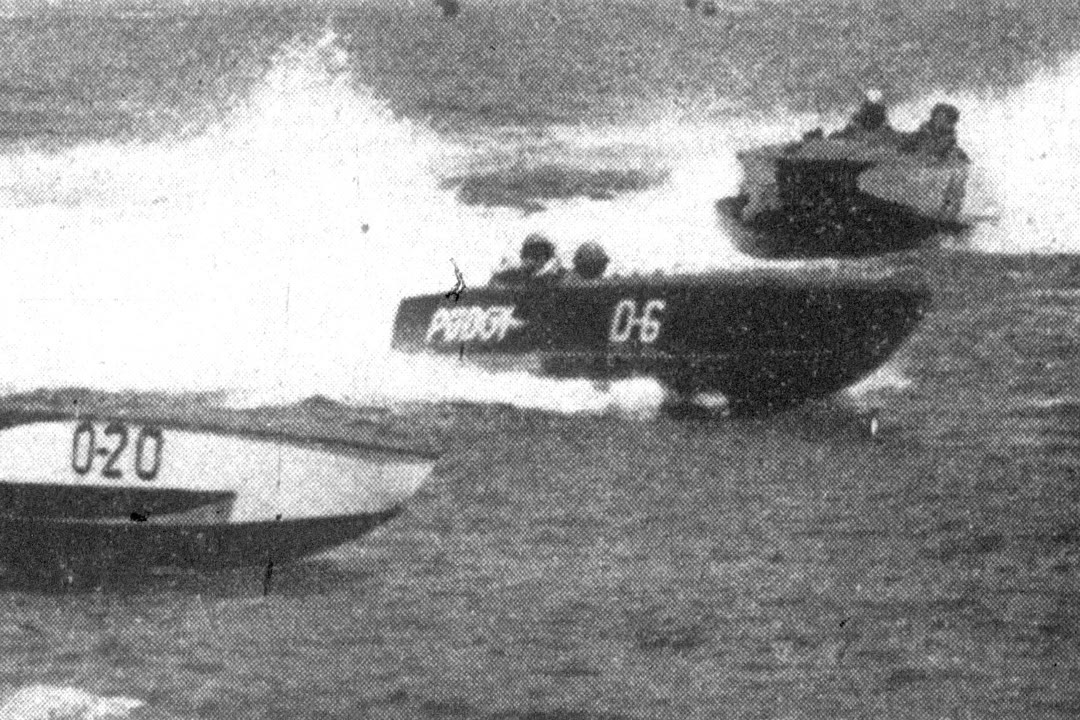
Under city rules, rowing has the stadium from sunrise to 8 a.m., and water skiing is allowed in designated areas from 8 a.m. until sunset. These days wakeboarders are a common sight too.
The boathouse at the end of Boathouse Lane is the Pete Archer Rowing Center. The city’s history says rowing clubs formed in Long Beach right after the 1932 Games, and that Pete Archer (1904 to 2001) coached all the city’s high school crews through the Long Beach Recreation Commission, along with recreational classes for men and women (City of Long Beach). In 2007 the center was expanded for new teen and adaptive rowing programs, with much of the money raised by the people who row there (City of Long Beach). Today it is home to Long Beach Junior Crew, which runs summer camps and learn-to-row programs (Long Beach Junior Crew), the Long Beach Rowing Association, which has a Learn to Row program for complete beginners (LBRA), and the Long Beach State rowing team (Beach Crew). On its March 2026 visit, row2k found the course in daily use by all three, with clubs regularly holding regattas there (row2k). The city also offers classes and private lessons at the center, with sign-ups through Long Beach Parks, Recreation and Marine.
Dragon boats, swimmers and a busy race calendar
Every July, Marine Stadium fills with dragon boats: long, narrow boats with dragon heads and tails, powered by a crew of paddlers, with a drummer up front setting the pace and a steersperson in the back. The Long Beach Dragon Boat Festival has run for more than 25 years, and Visit Long Beach calls it “one of the largest dragon boat competitions in California,” with teams from across the country. This year’s festival was on Saturday, July 25, and walk-up spectators get in free (Visit Long Beach; festival site).
The dragon boats are only one stop on a full calendar. The city’s 2026 list of Marine Stadium closures shows how many groups share this water (City of Long Beach):
- Summer: the Pan Pacific Swimming Championship (Aug. 6 to 10) and the Long Beach Mile (Aug. 13)
- Fall: Waves of Ability, an adaptive sports and wellness fair (Sept. 26), the International Elite Invitational Regatta (Oct. 8 to 10) and an Open Water Swimming Championship (Oct. 17)
- Still ahead: the Naples Island Collegiate Rowing Challenge (Saturday, Nov. 14), and the boat launch ramp closes for the Patchwork Show (Saturday, Nov. 28)
On event days the waterway, the boat launch ramp or both close to everyone else, so check the city’s Marine Stadium page before you head out on the water.
The Olympics come back
In the summer of 2028, the Games come back to the same water. LA28’s own venue page says 2028 “will mark the venue’s second time hosting events for an Olympic Games and first time hosting events for a Paralympic Games” (LA28: Marine Stadium).
Rowing, on a shorter course
Olympic rowing comes first, from July 15 to 22 (City of Long Beach), with heats on opening day and medal finals from July 17 to 22 (USRowing). There are 12 medal events, six for men and six for women, in the single sculls, pair, double sculls, four, quadruple sculls and eight (LA28: Rowing).
The races will be 1,500 meters instead of the usual 2,000. World Rowing explains that a full 2,000-meter course was in place in 1932, but a bridge built later shortened the available water to 1,500 meters for a six-lane race. LA28 will be the first time Olympic rowing is raced over that distance (World Rowing). The rowing site row2k names it as the J.H. Davies Bridge on Second Street, built in 1955, and measured exactly 1.5 kilometers from the starting hut to the near end of the bridge on a March 2026 visit (row2k).
Then the paddlers
Sprint paddle, the canoe and kayak sprint races, takes over from July 25 to 29 (City of Long Beach). That is 10 more medal events, raced over 200, 500 and 1,000 meters in kayaks and canoes for one, two or four paddlers (LA28: Sprint Paddle).
A Paralympic first
Para rowing runs Aug. 18 to 20 and para paddle Aug. 24 to 26 (City of Long Beach). Para rowing has five medal events: the PR1 men’s and women’s single sculls, the PR2 and PR3 mixed double sculls and the PR3 mixed coxed four (World Rowing). Para paddle adds 10 more, six in kayaks and four in va’a, the outrigger canoes (International Canoe Federation).
Just around the corner at Belmont Shore
The city’s schedule also puts three events at Belmont Shore: windsurfing and kite from July 16 to 20, open water swimming on July 17 and 18, and rowing coastal beach sprints on July 24 and 25 (City of Long Beach). The board events are men’s and women’s windsurfing and men’s and women’s kite (City of Long Beach). Beach sprints make their Olympic debut here, with a men’s solo, a women’s solo and a mixed double sculls (LA28: Coastal Rowing). Races start on the sand, sprint out through the surf and finish back on the beach (World Rowing). For a few weeks, the waters around our neighborhood will be some of the most watched in the world.
Seeing it for yourself
You do not need a ticket to enjoy Marine Stadium. The grassy banks and the path along the water are open to walkers, runners and picnickers, and early mornings are the best time to watch the crews train. Look for the landmark plaque near the rowing center, and in July, come back for the dragon boats. For more ways to get out on the water yourself, here is our guide to things to do on the water in Long Beach.
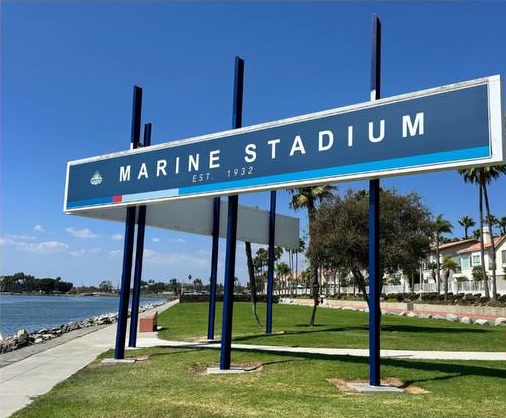
Marine Stadium just got an upgrade, too: a brand-new sign by the water, with 1932, the year of its first Olympics, right under the name.
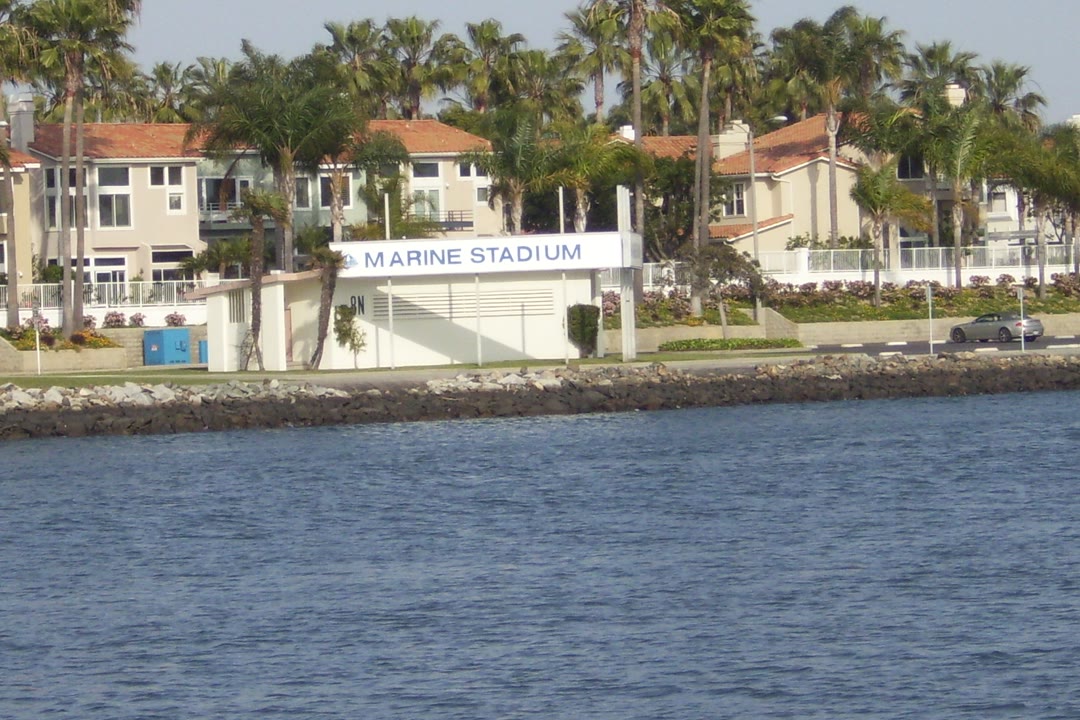
More changes are on the way. “Marine Stadium Improvements” is on the city’s list of Elevate ’28 projects ahead of the 2028 Games. Some things stay the same: the white finish-line building still spells out “Marine Stadium” in big letters.
If you are at Marine Stadium on a morning when the crews are out, listen for the coxswains calling out the stroke. It is the same sound that carried across this water in the summer of 1932.
Sources: Official Report of the Games of the Xth Olympiad, Los Angeles 1932 (rowing course pp. 70 to 73, results pp. 687 to 689; LA84 Foundation Digital Library); Official Report of the Games of the XXIIIrd Olympiad, Los Angeles 1984, vol. 1 (venues pp. 646 to 647); California Office of Historic Preservation: California Historical Landmark No. 1014, Long Beach Marine Stadium; City of Long Beach: Marine Stadium; City of Long Beach: Pete Archer Rowing Center; City of Long Beach: LA28; Long Beach Post: Marine Stadium’s Olympic debut, 1932 (Art Cohn’s Press-Telegram account); Visit Long Beach: Long Beach Dragon Boat Festival. Checked October 12, 13, 19 and 26, 2026. Photos are credited in each caption.